
What is a bowel obstruction?
Small bowel obstructions are ubiquitious in the world of general surgery. Most surgeons have one or two lingering on their in-house list at any one time. In the above post, I discussed an unusual cause of SBO, but over 90% are secondary to adhesions. What are adhesions? Scar tissue, baby. Anytime a surgeon has had his/her grubby hands inside your belly, it incites an inflammatory reaction that leads to the formation of fibrous bands and webs. The adhesions can form anywhere; bowel to bowel, bowel to liver, bowel to abdominal wall, just about anything. Generally, the scarring isn't a problem but you have to realize the intestines are constantly in motion, peristalsing and wiggling around inside your belly. Every once in a while, a segment of bowel will flop around a band of scar tissue and it will twist in such a way that the lumen gets either partially or completely occluded.
What does an SBO feel like?
Crampy abdominal pain. Your belly swells. You can't move your stool. You get more and more nauseated until you start vomiting bile in torrents of green. It's miserable, in a word.
What can I do to avoid one?
Nothing. It's not your fault, there's no dietary changes you can implement, no exercise regimen, nothing. A history of abdominal surgery gives you about a 10-20% risk of developing a significant bowel obstruction. Sometimes I use an adhesion barrier product called "Seprafilm" at the end of an open case in the hope that future adhesions will be reduced. There isn't a lot of science to suggest Seprafilm and its competitors actually work, but theoretically it's worth a try. For what it's worth.
What's the treatment?
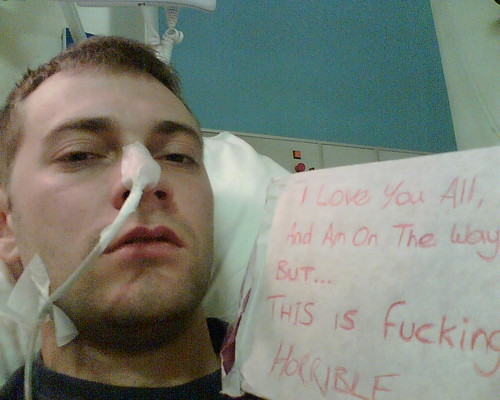
Most cases can be managed non-operatively. In fact, 70-75% of cases of SBO can be managed without the knife. The key tenets of management are bowel rest, nasogastric decompression, and aggressive rehydration. As a result of vomiting and third spacing of fluid in the bowel wall, patients can get quite dehydrated. You're going to need a couple of liters of saline pumped into you upon arrival in the hospital. And then you're going to have to endure the placement of the dreaded NG tube. On the list of top ten most painful things to undergo, getting an NG tube ranks just below "sawing off your own arm with a penknife to escape from underneath the giant boulder that has you trapped in the desert." Actually it's not that bad. Most of the time it goes in nice and smooth. Just lean forward, sip some water, and try not to fight it too much. The tube is very important and it needs to go down. It's a hose you drop into an overflowing toilet. The sump pump in your flooded basement. Usually a liter or two of foul, feculent greenish-brown slop gets sucked up immediately with a high grade obstruction.
When do you decide to operate Mr. Buckeye Surgeon?
Rarely is it necessary to zip someone off to OR the minute you see them in the emergency room. Bowel obstructions from incarcerated hernias and colonic obstructions obviously need immediate attention. But most SBO's can intially be managed non-operatively. The old adage "never let the sun set on a bowel obstruction" is a little dated. Sort of like catgut sutures and surgical residents working more than 80 hours in a week.
I monitor three things:
1. Pain: Increasing pain suggests bowel ischemia. This is the number one factor I pay attention to. Pain that develops despite NG decompression mandates a trip to the OR. Patients who present with pain will sometimes feel better after a couple hours of NG suctioning. The key thing is to examine the patient serially.
2. White blood cell counts: WBC counts ought to decrease over the first 24-48 hours. Persistent or rising counts are worrisome.
3. Xrays: Least reliable. If the NG is doing its job, the films may very well look better the following day. That doesn't mean the obstruction has resolved, though; it simply means the proximal bowel has been adequately decompressed. Persistent stacked loops of bowel, however, imply a possible closed loop obstruction (proximal and distal ends of a segment of bowel blocked), which will not get better without an operation.I also like CT scans for SBO's. It's a great tool for predicting the likelihood of spontaneous resolution of a patient's bowel obstruction. I look for transition points and possible occult hernias not appreciated on physical exam.
Ultimately, there is no magic formula. It's a judgment call. If the patient isn't progressing, then an operation is justified. The operation itself can often be one of the quickest abdominal procedures in all of general surgery. Sometimes it's a matter of one snip of a single band that has kinked the bowel. Other times, it can be one of the more stressful, time-consuming, and hazardous procedures one will encounter. Patients with multiple previous operations or those who have had radiation treatments for a previous cancer will develop what is known as a "frozen abdomen". Everything is matted together in a single mass. The fused loops of bowel almost look like the surface of a brain. Hours are spent just getting into the abdomen. It's an operation that demands patience and some cool tunes in the background. You can't rush. It shouldn't be a case you do at the end of a long day. Nor should it be the first case on a day when you have five others scheduled. I use the scalpel, for the most part. There's no role for electrocautery; not unless you want to take care of the patient's entercutaneous fistula in a few weeks. It's all sharp dissection, tediously slicing and shaving your way to something at least resembling normal anatomy. It's like carving a serpent out of cement. You can't go on autopilot, like for an inguinal hernia or an elective gallbladder. Every move is an act of improvisation....It's actually sort of fun.


27 comments:
My mother had an allergic reaction to Seprafilm and her intestines completely fused together. After removed of a benign ovarian cyst they noticed some adhesions on her intestines. She had intestinal surgery 30 years prior. They decided to removed the adhesions while they had her open and placed the Seprafilm. She eventually died after about 3 weeks of hospitalization. Have you had any experience with treating people that have severe reactions to Seprafilm? I know some people do live through it but I have also heard of others dying or having a large amount of their intestines removed.
WHAT FOODS SHOULD I BE EATING, I HAVE HAD 6 PARTIAL BOWEL OBSTRUCTUION THE LAST YEAR, THEY SEEM TO BE COMEING MORE OFTEN, I KEEP LOSING ALOT OF WEIGHT AFRAID TO EAT. ALSO IS THERE A GOOD ADHESION DOC HERE IN COLUMBUS OHIO. NEED HELP.
Anon-
There's no magic dietary formula that's going to prevent a future obstruction. There's probably some scar tissue causing some kinking of your bowels that intermittently causes these obstructions. The next occurrence may require surgery and lysis of adhesions to identify and fix the underlying problem
My son had a RPLND for testicular cancer 2 months ago and now he is unable to hold solids..they come back up green....He is pretty much on a liquid diet right now...he said he feels they food as it tries to go down and it feels like a lump and it trys to go back and forth and it painful and finally he throws up..does this sound like a bowel obstruction...after much research on the net I found where one guy had bowel obstruction after his RPLND....He had a series of test yesterday and is suppose to go to the surgeon who perform the RPLND today. Should he also check with a gastrologist for a 2nd opinion just to make sure before they cut him again.
THERE IS SOMETHING YOU CAN DO - DIET IS IMPORTANT!!! The link below is a good start and I recommend it to anyone who has suffered from bowel adhesions. I have learned that I will live the rest of my life susceptible to bowel obstructions (I am 40 yrs and have experienced 2 since I was 38 yrs due to borderline ovarian cancer treatment). http://www.bccancer.bc.ca/NR/rdonlyres/01B68B82-61CD-45A4-B71D-37A5A1318453/9329/LowFibreFoodChoicesPartialBowelObstruction1.pdf
For the last month I had not had a bowel movement and have been very bloated, I look like I am 5 months pregnant especially if I try to consume any type of food. For the last 2 years I have had problems with bloating off and on but I have never gone a month w/o a bowel movement. I used correctol, ex-lax, and a couple other laxatives with no luck at all. Then I used a enema with some results not a whole lot but better than nothing. Then when I had ulcers I remember Mylanta always made me have diarrhea so I bought a bottle and have been drinking that and I have diarrhea but I still have bloating. Previously I had no bowel sounds or gas and now my stomach is noisy with very minimal gas. I have not thrown up at all but when I wake up (that is if I ever get to sleep) It taste like I have thrown up in my mouth and it is so dang gross! This morning I woke up and It felt like somebody had beaten my belly with a baseball bat. I get alot of pain in my stomach and have started to get sharp pains in my back. I am 50 and have Rheumatoid and take pain killers, which I have been on for years so I dont know if it is because of them or what is going on. Everyone keeps saying I need to go to the doctor and I just recently like 2 days ago am eligible with insurance which is great. I just dont know If I am worrying about nothing and the diarrhea with the Mylanta is good or not. I just have a feeling if I quit drinking it I will cease to have anything at all and I still am bloated. Could someone please give me some good advice. I would appreciate it so very much. Thank you Franny
May of 2008 I went to one e.r.my belly was huge like I was 6-7 mths pregant and it hurt sooooooooo bad. w/o the dr. ever touching my belly or doing any kind of test he told me it was "gas" to go home and take an over the counter med for it.He was a dr. I trusted him and, did what he said.
2 days later I was in at another hospital e.r.I remember walking in and telling them how bad I was hurting.Next thing I knew 2 days had passed & I was in a recovery room with 34 staples in my belly.
Dr. at that hospital found not only a bowel obstruction but, also colon cancer.He said had I not came to e.r. that nite I would have died.I was in hospital 9 days then had to go do chemo.Just finished my last one.[hopefully] tests in next 2 weeks will say if the cancer is gone.
I also have to wear a colonostemy bag for a yr.Yr.is almost up.I thank God for sending me to the right e.r.dr.nurses and surgeon.Other wise I would not be here 2 day to raise my 7 yr. old g/daughter.God bless U all.
"Cyndy"
nice info doc
http://intestinal-obstruction.blogspot.com/
I have had two colon re-sections, in November of 2009, I had gall bladder surgery, in January, 2010 had blockage in intestine due to scar tissue, hospitalized with NG tube, IV, did not have surgery. Now I have diarrhea nearly every day. I am on a low residue, no fiber diet. Is there anything else I can do to prevent another blockage and also stop the diarrhea?
I had a small bowel obstruction ~ 3 years ago (proximal illeum). I had presented with abdominal pain and fullness (felt like someone punched me in the stomach). I had an OK bowel movement the day of the ER visit, but at 10pm I began to feel strange. I woke up at 2am with a punched in the stomach feeling and just knew something wasn't right. I went to the ER where they diagnosed my obstruction. In the end, it resolved itself in the ER without surgery. The cause was unknown, however adhesions are suspected (I had pelvic radiation as a child to treat a pelvic bone tumor (Ewings)). Now, I am very aware of my digestive system's mobility. I don't want to go through that again, considering how serious it can become.
Upon moving some heavy fixtures I fell into what has turned out to be almost 3yrs of pain, discomfort and concern for my health and future. After 5 months from the intial tearing internally and months of having 10's of thousands of dollars in tests, then surgery to remove a tumor that developed. I have now had 2 more colonoscopy/endoscopy and 2 more polyps removed in two yrs and am STILL having symptoms of partial obstruction. I have reoccuring pinching in my lower right abdomen especially aggravated by being on my feet for several days or trying to workout or exercise and severe pressure along with pain even into my back at times almost EVERTTIME I consume ANY type of food. I have had my children by c-section and had some mild repair work done after going into labor and having a wide vertical surgical hernia (opening in peritineal and muscle tissue) repaired. ALL of that ripped open on the onset of these symptoms. I literally felt things being pinched HARD and even blood circulation being cut off..blood pressure was average for me 80/60ish because I have had great health but immediately increased to an average of 120/80 I can not get a doctor willing to help me and cant help but believe it is directly related to the fact that I was being required to move heavy fixtures on my job when this happened. Since having and ON-THE-JOB-INJURY I believe I am being hung out to dry or more directly as though professionals are willing to allow me to end up with a polyp that turns cancerous before sticking their neck out risking and doing the right thing. CAN ANYONE HELP?? CAN ANYONE SEND ME TO A DOCTOR OR PATIENT ADVOCATE FACILITY THAT WILL HELP? I have been having to use MY own money and insurance for all of this since I dont' have the emotional wherewithall to have the added stress of the workmans compensation attorneys. I have been to some Top Dr's even at a top Hospitals and after they acknowledge ther is definetly a problem, was told "the only way to see and possibly fix the problem is to open you up but you dont WANT that". When I said, YES I DO so that all this will stop. I was then told that this surgical clinic (gastro surgical) doesn't do that surgery. Basically she was getting rid of me. HELP!!TIme is running out...pain and lack of sleep AND imparement of bowels going on consistantly too LONG..cant take the laxatives forever and they are TOO unhealty and no matter how much fiber I use I STILL have pinching and partial blockage..looking 5-6 months pregnant when you are 5'2" and under 120 is REALLY obvious. THANK YOU TO WHOMEVER CAN HELP ME! ..signed 'Pleading for my health back' ..By the way..I use to look 16 yrs younger just 3 yrs ago now only 5 or so less than I am, ALL due to this. I have most all of my years been way above average on taking care of my body and watching the food I eat..I am in my 40's..Please post this..thank you again and God Bless!
Upon moving some heavy fixtures I fell into what has turned out to be almost 3yrs of pain, discomfort and concern for my health and future. After 5 months from the intial tearing internally and months of having 10's of thousands of dollars in tests, then surgery to remove a tumor that developed. I have now had 2 more colonoscopy/endoscopy and 2 more polyps removed in two yrs and am STILL having symptoms of partial obstruction. I have reoccuring pinching in my lower right abdomen especially aggravated by being on my feet for several days or trying to workout or exercise and severe pressure along with pain even into my back at times almost EVERTTIME I consume ANY type of food. I have had my children by c-section and had some mild repair work done after going into labor and having a wide vertical surgical hernia (opening in peritineal and muscle tissue) repaired. ALL of that ripped open on the onset of these symptoms. I literally felt things being pinched HARD and even blood circulation being cut off..blood pressure was average for me 80/60ish because I have had great health but immediately increased to an average of 120/80 I can not get a doctor willing to help me and cant help but believe it is directly related to the fact that I was being required to move heavy fixtures on my job when this happened. Since having and ON-THE-JOB-INJURY I believe I am being hung out to dry or more directly as though professionals are willing to allow me to end up with a polyp that turns cancerous before sticking their neck out risking and doing the right thing. CAN ANYONE HELP?? CAN ANYONE SEND ME TO A DOCTOR OR PATIENT ADVOCATE FACILITY THAT WILL HELP? I have been having to use MY own money and insurance for all of this since I dont' have the emotional wherewithall to have the added stress of the workmans compensation attorneys. I have been to some Top Dr's even at a top Hospitals and after they acknowledge ther is definetly a problem, was told "the only way to see and possibly fix the problem is to open you up but you dont WANT that". When I said, YES I DO so that all this will stop. I was then told that this surgical clinic (gastro surgical) doesn't do that surgery. Basically she was getting rid of me. HELP!!TIme is running out...pain and lack of sleep AND imparement of bowels going on consistantly too LONG..cant take the laxatives forever and they are TOO unhealty and no matter how much fiber I use I STILL have pinching and partial blockage..looking 5-6 months pregnant when you are 5'2" and under 120 is REALLY obvious. THANK YOU TO WHOMEVER CAN HELP ME! ..signed 'Pleading for my health back' ..By the way..I use to look 16 yrs younger just 3 yrs ago now only 5 or so less than I am, ALL due to this. I have most all of my years been way above average on taking care of my body and watching the food I eat..I am in my 40's..Please post this..thank you again and God Bless!
In my experience there is a solution for most bowel obstructions short of the dreaded NG tube.
I had surgery for a bowel obstruction in 1949 (5 yrs. old; I'm 66 now) and have had emergency surgeries for lysis of adhesions in 1975 and 1983 and an elective lysis surgery in 2008; during those years, in addition to surgeries, I had many experiences with the NG tube. From 2006-08 I averaged 12 or more full obstructions per year. I've had 7 full obstructions since my 2008 surgery, which included Seprafilm. (Since 2006 I have also had partial obstructions, accompanied by bloating, discomfort, and diarrhea, much of the time.) Incidentally I have never experienced nausea or vomiting during a full or partial obstruction.
The solution w/o NG tube? I have a prescription for oxycodone (5 mg). In almost every instance I have experienced of a full obstruction, 2 oxycodone will do the trick. I don't take them until the pain is very intense (5 on a 1-10 scale; i.e., you're trying to keep from screaming). In about 20 minutes the pain abates, then disappears, and so, apparently, does the obstruction.
On July 11 of this year I had to take a second dose of two pills after an hour and a half waiting for the first two to kick in. In every other instance but two in 2006, when the pills didn't work and I had to be hospitalized and intubated, I have successfully dealt with the blocks at home. I have been doing this since 1991.
I hope that more doctors will suggest this approach to my fellow-sufferers.
I have experience with a way to avoid the dreaded NG tube during obstructions.
My first bowel obstruction surgery was in 1949 (I was 5 years old--now 66), with emergency surgeries for lysis of adhesions in 1975 and 1983 and elective lysis surgery in 2008, with many experiences with the NG tube in my younger years. From 2006 to 2008 I had 12 or more full obstructions per year. So far in 2010 I have had 7 full obstructions and am partially obstructed much of the time, with diarrhea five out of seven days, from 5 to 20 times per day. I also have Small Bowel Bacteria Overgrowth.
My answer to full obstructions? Two oxycodones (5 mg.) cause the pain to abate and, apparently, the obstruction to work itself out, as the drug reduces motility and relaxes the intestine. (I don't take the pills until the pain has reached a level 5/10--you're trying to keep from crying out.) The pills take about 20 minutes to work.
I've had a script for this approach since the mid-90's and it has saved me from many hospital trips and intubations. On two occasions, both in 2006, the drugs didn't work and I had to be intubated. On one occasion this summer (in Italy) I had to take two more pills after the first two didn't work for an hour and a half. Still in most instances this approach is very successful
I hope more doctors will recommend this approach to my fellow sufferers.
OMG! where have you been all my life...for the past 11 years. i've been in hell, and pretty much every doctor has some stupid suggestion. eat low residue, eat More fiber....take anti-depressants. Don't take pain killers. half treat me as though i'm drug seeking (which is Insane, given my abdominal scars and port-a-cath)...the other half just want to say stupid things like "oh you poor thing...you're too young." NO one will help me, or even Think of doing surgery. and i would do almost anything for even 6 months of no pain!!!! i've been suicidal off and on for years because of the pain and the constant trips to the ER. unpredictable and frustrating. stress Definitely compounds the issue...but what Doesn't?
For two years I was seeing my primary care physician and an gastroenterologist for intermintent stomach pain. The initial complaint was severe constipation something I had never experienced before lasted a few months. Was sent for many test, CT, MRI, gall bladder test etc. History of mild IBS but symptoms were never more than bloating and gas and would be helped with OTC gas X or similar product. When this started in 2004 I would have severe pain and it would last 20 min or so but so severe I couldn't drive or had to leave wherever I was.
I was not diagnosed until I wound up in ER when pain would not let up I waited hours. Surgeon took more test and wanted to wait and see if the tube would held and the obstruction would go away as it had before but this was different. Had surgery and felt better immediately. My concerns are that it comes back. I have a lot of stomach noise and mentioned it to the gastro. but he said it was OK. I worry about that because prior to the surgery I had the stomach noice too.
I know I am likely to have this happen again last time I was in hospital 7 days prior to deciding nothing was working and I agreed to surgery.
After all that my question is how much follow up should I do if I am pain free now and follow with Miralax 2x a week and fiber supplement daily. Should I question the doctor more about the stomach noice? This seems trivial but prior to the initial problem in 2004 I rarely had a noisy stomach but now even when I move it sometimes gurgles.
I have been suffering from partial obstructions for years now. I average about 6 per year and they are caused by scar tissue from previous surgeries to remove crohn's disease. I have been trying to control with diet as best I can, but I can't seem to find any correlation besides potentially eating too much at once. 2 OXYCODONE's work wonders for me as well. Alternately, 2 TYLENOL 3's with codeine. I take them and go right to sleep. I would say this solution works about 70% of the time. Unfortunately, the other 30% of the time, I still end up in the ER. I've also found that if I start to feel the "blockagey" feeling...even a twinge that something might be obstructed, it's best to stop eating altogether. Even if it takes 12 hours to work itself through, it's substantially better than a visit to the ER. Just sip water until the feeling goes away. This has to be right when you first notice anything is "off". Not when it's too late. Finally, if you do end up having to take a visit to the ER, morphine or fyntenol work wonders for me. I can literally "feel" the blockage move on it's own. It's usually pretty painful, but once it's gone, it's gone for good. This happens almost instantaneously for me.
I am a cancer survivor and had abdominal radiation and surgery as treatment for the cancer 15 years ago. I had a full obstruction shortly after and had what the Buckeye Surgeon described as frozen abdomen. For the past 15 years I have been suffering from what I believe to be partial obstructions with pain after every meal and what I playfully refer to as constipated diarrhea...the cycle is eat, bloating and pain, bloating and pain, much struggle (in the form of suppositories or enema and abdominal massage) and finally diarrhea...Only to do it all again next meal. Two things that I feel keep me from another full obstruction: Bikram yoga. The compression and stretching really work the abdominal organs. It has been amazing for my lymphedema and honestly keeps my intestines more supple. And visceral self massage. I actually do this during and after the Bikram practice as well as after meals. I use a lot of peppermint oil when in great pain and mix the peppermint oil with grapeseed or almond oil for massage.
I am going to try Graston Therapy which is supposed to break up scar tissue but is typically used for muscular therapy. I am still looking for a therapist who will help tackle my twisted mass. (Maybe I should recommend cool tunes...:)
Thanks so much for the info and comments. It is nice to see that I am not alone in this pain.
Just Out Of Hospital......
I have just been released from hospital after 4 days of hell.I have always been treated for adhesions with morphine and a drip but this time,I got the DREADED N/G TUBE. OMG I never want to go through that again.And yes the doc above who said it's like being awake and having your leg sawn off is right.If anyone has any diet tips or like the oxycodone tip or any tips at all that may prevent an attack please post.!!!! thanks one and all.
This is the 2nd time I have tried to post here.
Been out of hospital for just one week and here I am with the dreaded adhesions again.I am doing my uetter best not to go to hosp as I can't face the N/G tube.Anyone got any other diet or pain relief tips ?
thanks
L.
To everyone asking this doctor for advice & making requests for treatments; he cannot answer you. Due to LAW & the rules stipulated by HIPAA, not to mention the fact that there are some sue happy dingalings, why would/should he risk his license to answer some of these? Taking Percocet for a bowel obstruction is borderline dangerous/stupid. If you take narcotics long term, you have a high risk of developing chronic constipation & it can worsen "gut trouble." Talk to your primary care physician instead of running to the ER. Common sense dictates that if you do not like/trust your primary care physician that you seek out a new one! I am sorry for your suffering but some of the things these comments mention are scary & dangerous. Please, do not take ANY advice left in comment sections or anywhere on the internet without speaking to a REAL doctor, who knows your history & condition(s). Bowel obstructions are dangerous & can KILL YOU!
I suffered a major heart attack in March of 2014 and had multiple shocks and prolonged CPR. My last days in hospital I had some sharp pains in my abdomen and was told that it was just my bowel waking up from all the trauma. So for three months I have been in pain 10-12 hrs a day, unable to eat any solid food and have lost over 30lbs of body weight. Granted since the end of March I was seeing a Gastroenterologist, who sent me for one test after another with no real alarm at my weight loss or pain. Finally my last test at the beginning of June a small bowel series showed a partial obstruction in the proximal small bowel and surgery was suggested. I was then sent to a General Surgeon and Surgery was scheduled, unfortunately, the anesthesiologist refused to sedate me due to my weakened heart. Any suggestions of what my options are? I have never been offered any conservative treatment such as GI Tube and fluids, and frankly if I don't do something soon my whole body chemistry is going to be out of whack from malnutrition.
For how many days can you treat patient For sbo with conservative management (no gas no stool)
How common is small bowel obstruction post cesarean section?
My mother hardly is terribly sick. Its been a couple of years and whenever she eats anything her stomach swells. Recently the situation worsened We went to the doctor he said its alot of inflammation in the intestine he suggested a ct scan, the results showed she had bowel loops. I am worried please help me. Anybody knows any cure to this apart from surgery
What works for me is drinking hot water and as much as you can, i too have ended up in the ER a few times without a real diagnosis or help. I know the feeling as soon as it starts and hot water really helps. It kind of disolves the blockage so it can pass. I have gone from completely doubled over throwing up to better in no time if you can just get the hot water down.
I had a HAL left nephrectomy on Oct 9th. Four weeks later I was in the emergency screaming in pain for four hours. IV morphine did nothing to relieve the pain. IV dilaudid helped for about ten minutes. The NG tube was really unpleasant but over quickly. I spent the night alternating between sleep, groaning and begging for more pain meds. After a bunch of tests, the nurses rushed me to the OR at about three in that afternoon.
It is my understanding that the nephrectomy left a hole in the mesentery, and my small intestines had crawled through the hole and died. The surgeon removed 160 cm of necrotic small intestines. He told me that I had won the lottery. Evidently this complication from HAL nephrectomy is super rare. I'm a zebra. LOL Somehow I don't feel very lucky, but I'm alive.
Post a Comment